

There’s more to owning a home in Ontario than just buying it. How you hold title affects control, decision-making, and what happens when it’s time to refinance, transfer, or sell.
Most people focus on price, layout, and location, which matter, but you also need to be aware of how the property is owned and carried forward well beyond the purchase. Ownership affects your ability to use the property, the decision-making process among owners, and the ease with which things proceed if your circumstances change.
Where ownership on the title matters.
Across Canada, the most common form of ownership is still freehold. Recognizing this helps buyers feel more confident in their choices, reducing uncertainty about control and independence over their property.
Condominium ownership has also increased in Kingston and nearby regions. As prices rise and land becomes tighter, condos offer a different approach. You hold title to your individual unit, but a corporation collectively manages the building and shared spaces. Buyers considering that route should understand how fees, rules, and long-term costs work before committing, so they feel prepared for community living.
After clarifying that difference, the next stage is to grasp how the title reflects ownership.
Sole ownership
When a single person purchases a property, they typically gain exclusive ownership, meaning their name is on the title, and they alone make all decisions. This streamlined process benefits individual buyers.
On the surface, it is straightforward.
In Ontario, a matrimonial home designation can apply to property where a legally married couple lives, granting both spouses rights irrespective of title ownership, a fact crucial for buyers to understand.
The designation surprises many sellers, especially when one person owned the home before the relationship. Once the property becomes the family home, the legal treatment changes. These rules apply to married couples, not common-law relationships, which is where much of the confusion starts.
In Ontario, this is not just a legal concept. It shows up directly in the Agreement of Purchase and Sale (OREA Form 100).
There is a section where the seller confirms whether spousal consent is required under the Family Law Act. If the property is a matrimonial home, the spouse must sign a consent confirming the sale. Without that, the transaction cannot move forward.
Even where a seller is the only person on the title, that question still has to be addressed. It is one reason ownership on title and actual rights to the property are not always the same.

Form 100 also includes a spousal consent section where a non-titled spouse signs to acknowledge and consent to the sale when required.

Joint tenancy
When two people buy a home together, joint tenancy is often the starting point, particularly for married couples; each owner has an undivided (shared) interest in the property.
Both owners hold the property together. This type of ownership creates a right of survivorship , so when one owner dies, the other owner absorbs the deceased owner’s interest. It does not go through the estate, and there is no delay.
That simplicity is the reason many couples choose it. A direct property exchange, agreed upon and planned by both sides, is the key to success with this strategy.
Tenants in common
Tenants in common take a different approach.
Each owner holds a defined share of the property, which can be equal or unequal, reflecting different financial contributions. A will or estate plan provides a method for bequeathing or conveying this share, affecting inheritance and tax considerations; unlike what occurs in joint tenancy, there is no right of survivorship. It is important to remember that any tenant in common can transfer their portion while they are still alive.
People often use this structure when ownership is not straightforward. Investment properties, purchases between friends or family members, and second relationships are common examples.
Choosing the right structure
Most situations do not require over-complication, but the ownership structure must align with the property’s actual use.
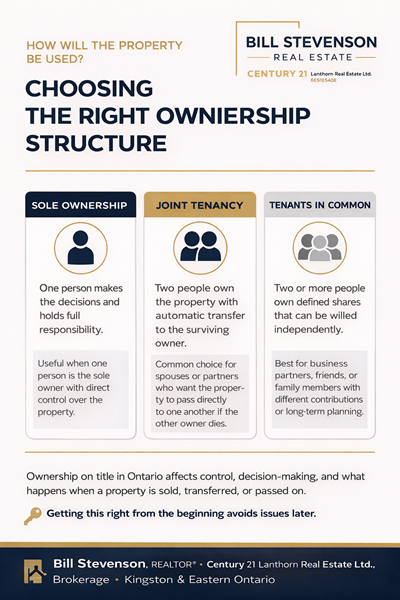
Sole ownership works when one person decides and carries the responsibility. Joint tenancy often suits two mutually aligned people who wish for the property to pass directly to the other owner. Tenants in common become more relevant when contributions differ or when longer-term planning is part of the decision.
The right choice usually comes down to how the property fits into your plans, not just today but in the future. Use, control, and what happens if circumstances change are all factors in the structure that makes the most sense.
FAQ
What is the most common type of ownership in Ontario?
Freehold ownership is the most common, where the owner holds title to both the home and the land. This includes most detached homes, semis, and many townhouses. Condo ownership is also common, especially in cities and regional centres like Kingston, where buyers are looking for a more affordable entry point or less day-to-day maintenance.
What is the difference between joint tenancy and tenants in common?
The main distinction rests on the ownership structure and the events following an owner’s death. Joint tenancy includes the right of survivorship, meaning the surviving owner automatically receives the deceased owner’s share. Tenants in common do not include survivorship. Therefore, each owner’s share becomes part of their estate and they can will it to someone else. The right choice depends on whether simplicity or flexibility is the priority.
Can a spouse have rights if they are not on the title?
The property is typically a matrimonial home when a lawfully married couple lives in it together. As a result, the property belongs to both spouses, despite only one being legally named on the title. In addition, they must jointly agree on selling or refinancing the home. This is one situation where ownership on paper does not fully reflect legal rights.
Does this apply to common-law relationships?
No, not in the same way. Common-law partners do not have automatic property rights under Ontario law, and ownership usually follows title. Having children together does not change ownership of the home, although it may affect support or living arrangements. This is an area where many assumptions do not match how the law actually works.
Is it possible to change ownership after purchase?
Post-closing, ownership changes require legal work and potentially lender approval. Depending on its structure, the change could involve costs or tax effects. It is usually simpler and more cost-effective to choose the right ownership structure at the time of purchase.
Don’t Miss These Guides
Ownership structure is only one piece of the decision. Most buyers have a few bigger questions running in the background as well, especially around affordability, timing, and risk.
These guides will help you see the connections if you are working through those.
Match the Home You Buy to Your Budget: What Kingston Buyers Need to Know
Understanding ownership is important, but the numbers still have to work. Beyond the sticker price, this guide details what buyers need to consider, including planning for shifts.
Ownership structure matters, but timing can matter just as much. The guide outlines how to approach your next move based on your financial position and risk tolerance.
Home Inspections: Benefits for Buyers and Sellers
Before committing to any ownership structure, it is important to understand the condition of the property itself. This guide explains what inspections uncover and how they factor into negotiations.
Condo Living in Kingston and Area in 2026–Downsizing Now?
If you are considering a condo instead of freehold, this guide gives a clearer picture of fees, rules, and what ownership actually feels like day to day.
Working with a Kingston REALTOR®
If questions like ownership structure, timing, and negotiation overlap, this outlines how guidance and representation fit into the process from start to finish.