


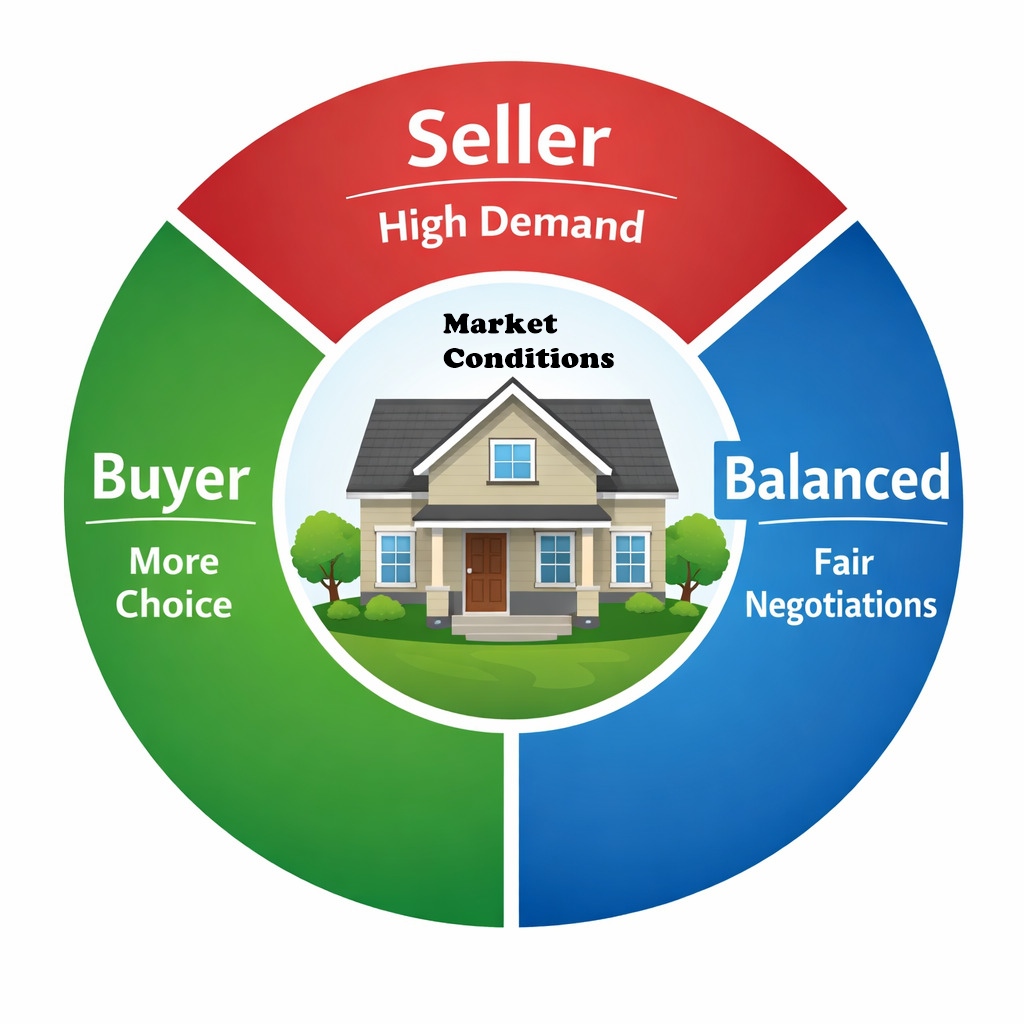
Experts often label real estate market conditions as buyer’s, seller’s, or balanced markets, but understanding their implications is key to making informed decisions, not just headlines.
In reality, market conditions influence far more than price. They affect how much time buyers have, how much risk they take on, how negotiations unfold, and how realistic sellers need to be about outcomes. They also change from place to place and from one price range to another.
Kingston and the area exemplify this, as their market segments behave differently from Toronto or Vancouver, making local knowledge crucial to avoid costly mistakes.
What a seller’s market really looks like
A seller’s market occurs when demand clearly exceeds supply. There are more buyers than homes available, and competition drives the process.
Most people remember the most extreme version of this during COVID. Inventory was historically low, buyers were plentiful, and listings often sold within days. Multiple offers were common, prices escalated quickly, and buyers frequently waived conditions such as home inspections or financing to stay competitive.
In that environment, sellers held most of the leverage. Pricing aggressively often worked. In that environment, sellers held most of the leverage. Pricing aggressively often worked. Buyers had little time to reflect, and they frequently decided under pressure.
It is essential to recognize that COVID represented an extreme seller’s market, not a normal one. It rewarded speed and risk-taking, but it also exposed buyers to problems that only surfaced after closing. You should not treat those conditions as a baseline for how real estate usually functions. This approach helps you feel more grounded and less uncertain about today’s market.
What changes in a balanced market?
A balanced market sits between extremes. Supply and demand are more evenly matched, and neither buyers nor sellers dominate the process.
Balanced is where Kingston and the area broadly sit today. Homes still sell, but they do not vanish overnight. Buyers have time to think. Sellers still achieve fair market value, but only when pricing and presentation align with current conditions.
One of the most critical shifts in a balanced market is not price, but choice.
Buyers regain the ability to compare homes, evaluate neighbourhoods, and decide based on suitability rather than urgency. Conditions such as home inspections and financing approvals return to normal. Negotiations are less about winning and more about making sense.

For sellers, balanced markets reward preparation and realism. Buyers expect transparency and proper pricing. Homes that rely on yesterday’s momentum linger, while well-presented, well-priced properties continue to move.
Balanced markets are often the healthiest over the long term, especially for buyers and sellers who plan to stay put for several years.
When the market leans toward buyers
A buyer’s market develops when supply exceeds demand. There are more homes for sale than active buyers, and listings take longer to sell.
In Kingston, we are seeing buyer-leaning conditions emerge most clearly in condominiums and higher-priced homes. Inventory is higher, days on market are longer, and buyers have meaningful leverage again.
The reality does not mean prices are collapsing. It means buyers have options.
In buyer-leaning markets, purchasers can take a more deliberate approach. Pricing discussions become more flexible. Home inspections, financing conditions, and longer closing dates are reasonable and expected. Buyers can focus on value, condition, and long-term suitability rather than rushing to secure anything available.
For sellers, this environment requires change. Pricing must reflect today’s competition, not last year’s peak. Presentation and timing matter more. Buyers are selective and quick to move on if the value is unclear.
Understanding current market conditions helps explain why pricing, negotiations, and timelines feel different from what they did just a few years ago. Recognizing these changes can make you feel more in control and better prepared to adapt your strategies accordingly.
Why market type affects risk, not just price
One of the most overlooked aspects of market conditions is how they affect risk, particularly for buyers planning to stay in a home for only a short period.
In strong seller’s markets, short-term ownership can sometimes work, although it still carries risk. In balanced or buyer-leaning markets, that risk increases. Transaction costs alone can erase gains, and if prices soften or stall, exiting quickly becomes more difficult.
Explaining market trends is especially relevant today, as some clients, both buyers and sellers, still carry COVID-era expectations into a very different market. The danger is not buying in a balanced or buyer-leaning market. The threat is behaving as if it is still 2021.
Where Kingston and the area fit today

Overall, Kingston and the area have moved away from extreme seller conditions and into a more balanced environment, with clear buyer-leaning behaviour in specific segments. Detached homes remain relatively steady, while condos and higher-priced properties show longer selling times and more negotiation.
A single thing cannot describe the current market; neighbourhoods, property types, and price ranges matter more than broad labels.
Patience and preparation will reward buyers during this time. For sellers, success depends on understanding where your home fits within the market, not where the market used to be.
The takeaway
Buyer’s markets, seller’s markets, and balanced markets are not good or bad in isolation. They are environments that require different approaches.
The mistake is not buying or selling in a particular market. The mistake is ignoring how the market has changed.
In today’s Kingston market, understanding how current conditions influence your timing, risk, and plans is essential for success, requiring strategy adjustments accordingly.
The right question is no longer “Is it a buyer’s or seller’s market?”
It is, “How does this market affect my timing, risk, and long-term plans?”
Also check our guide Selling your home: 20 questions to ask before Listing
and 20 Kingston Home Buying Questions: Ask Before Buying a Home
Frequently Asked Questions
What do “market conditions” actually mean in real estate?
Market conditions reflect the supply and demand equilibrium at a specific moment.They influence how many homes are available, how quickly they sell, how much negotiation is possible, and how much risk buyers and sellers take on. Neighbourhood, price range, and property type cause market conditions to vary and not remain fixed.
Is Kingston currently in a buyer’s or seller’s market?
Overall, Kingston and the area are closer to a balanced market, with some segments leaning toward buyers. Condominiums and higher-priced homes are more buyer-friendly, while well-priced detached homes can still sell steadily. It is no longer an extreme seller’s market like it was during COVID.
Why do balanced and buyer-leaning markets give buyers more options?
In balanced and buyer-leaning market conditions, buyers usually have more homes to choose from and more time to decide; this makes conditions such as home inspections, financing approvals, and negotiations on price or closing dates more reasonable and expected.
Do homes still sell well in balanced markets?
Yes. Homes that are priced appropriately and well presented continue to sell in balanced market conditions. The change is that buyers are more selective and less willing to overlook issues or overpay to secure a property.
Is it risky to buy in a buyer’s or balanced market?
The market itself is not the risk. Risk comes from misaligned expectations or short-term plans. Buyers who intend to stay only one or two years need to be especially careful in balanced or buyer-leaning markets, where price growth may be slower and transaction costs matter more.
Should sellers wait for a seller’s market before listing?
Trying to time the market perfectly is rarely successful. Instead, sellers are usually better served by understanding current market conditions and adjusting pricing, presentation, and expectations accordingly.
📚 Don’t Miss These Guides
Market conditions influence how buyers and sellers approach real estate decisions. Whether the market favours buyers, sellers, or sits somewhere in between, understanding the broader housing landscape can help people make more confident decisions in Kingston and the surrounding Frontenac, Lennox, and Leeds communities. These related guides provide deeper context and practical next steps.
First Home Purchase: Kingston Area
A step-by-step guide for buyers who want to understand financing, inspections, budgeting, and long-term affordability when purchasing property in Kingston and the surrounding Frontenac, Lennox, and Leeds communities.
A practical look at timing, preparation, and emotional considerations when selling a long held property, helping families navigate the process in Kingston and the surrounding Frontenac, Lennox, and Leeds communities.
Condo Living in Kingston and the Area
An in-depth look at condominium ownership, monthly fees, resale considerations, and how the condo market can behave differently from detached homes in Kingston and the surrounding Frontenac, Lennox, and Leeds communities.
Relocating to Kingston and the surrounding areas
What out-of-town buyers should understand about neighbourhoods, pricing, and local housing trends before making a move to Kingston and the surrounding Frontenac, Lennox, and Leeds communities.
External sources
For readers who want more background on how real estate market conditions are measured in Canada, the following organizations publish widely used data and definitions:
-
-
Canadian Real Estate Association (CREA)
National and regional housing statistics, including months of inventory and sales-to-new-listings ratios used by Canadian real estate boards. -
Kingston and Area Real Estate Association (KAREA)
Local MLS® data for Kingston and surrounding communities, including inventory levels, pricing trends, and market balance indicators. -
Canada Mortgage and Housing Corporation (CMHC)
Canadian housing research, affordability analysis, and market outlooks affecting buyers and sellers. -
Market conditions can vary by neighbourhood, property type, and price range. Local data matters more than national headlines.
-