


The June housing market in Kingston and area showed increased activity compared to May, but the rising supply of homes continued to favor buyers, highlighting current market dynamics for informed decision-making.
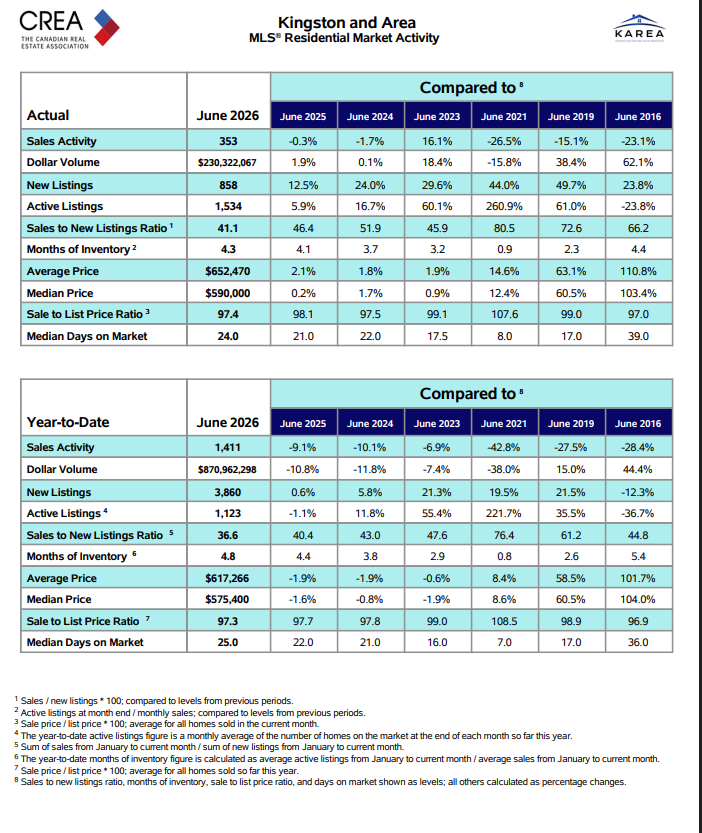
In June, the market saw the sale of 353 residential properties. That was almost identical to the 354 sales recorded in June 2025, representing a year-over-year decline of only 0.3%. The average sale price increased 2.1% to $652,470, while the median price rose just 0.2% to $590,000.
Those price figures suggest a sense of stability, which can reassure buyers and sellers alike, as the market remains a buyer’s market with prices stable but inventory rising.
What the June housing market showed
There were 858 new residential listings during June, an increase of 12.5% from the 763 properties listed one year earlier. Active inventory reached 1,534 homes, up 5.9% from June 2025 and 16.7% from June 2024.
The June housing market shows that the average home sold for 97.4% of its final asking price. The median time on market was 24 days, compared with 21 days in June 2025.
The sales-to-new-listings ratio, showing over 2 new listings for each sale, illustrates the ongoing buyer’s market and helps gauge market balance.
That gave buyers more time to compare homes, review recent sales, and consider a property’s condition before making an offer. Sellers could no longer rely on limited inventory to create urgency.
June sales increased from May.
Considering normal seasonal changes, June was considerably more active than May. For comparison, the May 2026 Kingston and area housing market update showed 317 sales, fewer than the 353 recorded in June.
Seasonally adjusted residential sales increased 13.1% from the previous month. New listings rose 3.9%, while active listings increased 5.2%. The seasonally adjusted average price was $656,527, down 3.1% from May.
The increase in sales was encouraging after a slower start to the year. It showed that buyers were still willing to purchase when they found the right property at a price they considered reasonable.
The increase was not strong enough to absorb the inventory. More homes continued to come onto the market, keeping pressure on sellers to price accurately from the beginning.
Kingston and area remained a buyer’s market.
The seasonally adjusted sales-to-new-listings ratio was 36.9% in June. Months of inventory stood at 5.6, compared with 4.5 months in June 2025.
The numbers continued to support a buyer’s market.
The unadjusted monthly data showed a sales-to-new-listings ratio of 41.1%. Unadjusted inventory reached 4.3 months, up from 4.1 months one year earlier and 3.7 months in June 2024.
The June housing market did not mean that every buyer could expect a substantial discount. Well-maintained homes in desirable locations could still attract quick interest, especially when the asking price reflected recent comparable sales.
The difference was that buyers usually had alternatives. Buyers more often moved on to another property if a home’s price was too high, if it needed substantial repairs, or if its terms were unacceptable.
Single-family homes remained the strongest segment.
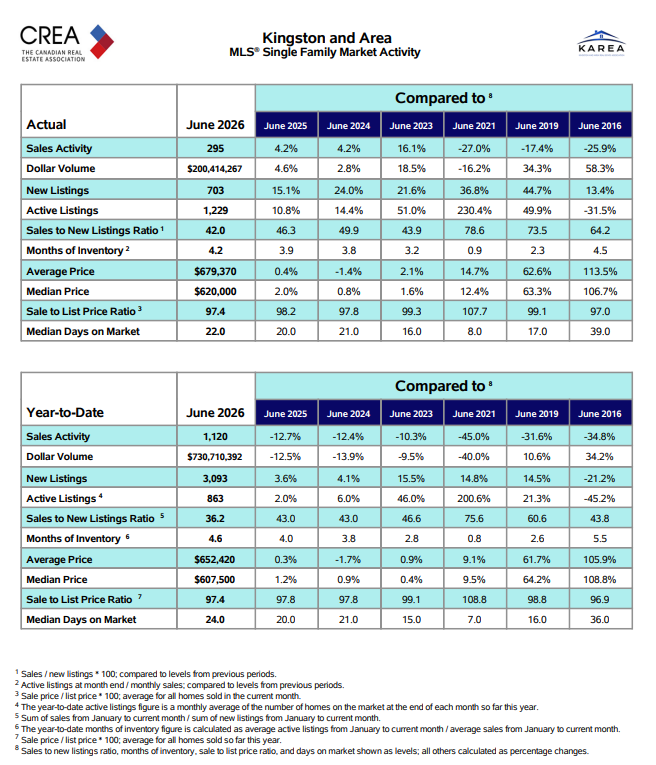
Single-family homes accounted for 295 of the 353 residential sales recorded during June.
Sales in this category increased 4.2% from June 2025. The average price was $679,370, up 0.4%, while the median price rose 2% to $620,000.
There were 703 new single-family listings, an increase of 15.1% from last June. Active inventory rose 10.8% to 1,229 properties.
On average, single-family homes took 22 days to sell and went for 97.4% of their listed price.
The increase in sales showed that demand remained strong, but buyers also had a considerably wider selection. Pricing, property condition, and location continued to influence how quickly a home attracted an offer.
Townhouse sales slowed during June.
The townhouse segment was softer than the single-family market.
Thirty townhouses sold during June, down 18.9% from the 37 sales recorded one year earlier. The average price fell 5% to $496,980, while the median price declined 4.5% to $511,000.
Townhouse inventory reached 3.2 months, compared with 2.8 months in June 2025. The median time on market improved from 25 days to 21 days, although fewer properties sold.
Year-to-date townhouse sales were slightly higher than they were at the same point in 2025. Average and median prices, however, remained approximately 5% lower.
Buyers considering townhouses had more opportunity to compare location, condition, property taxes, and any monthly maintenance or condominium fees before deciding.
Apartment and condominium buyers had the most choice.
The apartment segment continued to have the highest inventory level among the main residential property types.
Only 17 apartments sold during June, down 29.2% from one year earlier. The average sale price was $414,471, a 3.8% decline, while the median price fell 20.5% to $320,000.
Monthly apartment figures can move considerably because the number of sales is relatively small. The types, sizes, and locations of the units sold can have a major effect on the average and median price.
Even with that caution, the inventory figures clearly favoured buyers. Apartment inventory reached 7.2 months, properties spent a median of 40 days on the market, and the average sale-to-list-price ratio was 96.6%.
Condominium sellers need to consider more than the broad market average. Monthly fees, reserve fund strength, planned repairs, parking, location, and the condition of the unit can all affect buyer interest.
The first half of 2026 remained slower than in the first half of last year.
From January through June, 1,411 residential properties sold across Kingston and the surrounding area. That was 9.1% fewer than during the same period in 2025.
The year-to-date average price was $617,266, down 1.9%, while the median price was $575,400, down 1.6%. New listings rose slightly to 3,860.
Year-to-date months of inventory increased from 4.4 in 2025 to 4.8 in 2026. The median time on market rose from 22 days to 25 days.
The first half of the year, therefore, produced fewer sales, more selection, and modest downward pressure on prices. June was more active than May, but the improvement did not erase the slower results recorded earlier in the year.
What June meant for buyers
For buyers, the June housing market offered more opportunity to shop carefully rather than react immediately to every new listing.
Financing, inspection, insurance, water testing, and septic conditions were more likely to be considered than they would have been during a highly competitive seller’s market. Buyers also had more time to compare neighbourhoods, renovation needs, and ongoing ownership costs.
Suitable homes could still sell quickly. A property that was properly priced and offered strong value could attract several interested buyers. The advantage was that buyers were less dependent on securing one particular home and could walk away when the price or terms made little sense.
What the June housing market meant for sellers
Sellers needed to compete for buyer attention from the first day their property entered the market.
An asking price that was noticeably above recent comparable sales could cause buyers to focus on other listings. Sellers might need to change the price before interest improved once a home had remained available for several weeks.
Photography, cleanliness, repairs, and presentation also mattered. Buyers could quickly compare similar homes, and relatively minor differences could influence which listings they viewed.
The sale-to-list-price ratio of 97.4% showed that negotiation remained common. Sellers needed to be prepared for discussions involving price, closing date, repairs, and conditions rather than assuming buyers would accept the original terms.
Buyers continued to hold the advantage.
Overall, the June housing market brought a welcome increase in activity compared with May, while prices remained reasonably stable compared with last year.
The larger supply of homes continued to shape the market. Buyers had choices, homes took longer to sell, and sellers faced more pressure to price accurately.
Conditions can vary considerably by neighbourhood, property type, price range, and condition. A well-priced single-family home may perform differently from a condominium, a rural property, or a home requiring substantial repairs.
Focusing on the specific market segment relevant to an individual property is increasingly important. The overall Kingston and area averages provide useful direction, but they do not tell every buyer or seller exactly what to expect.