



Considering owning or already owning rental property? Many property owners in Kingston and across Eastern Ontario built their rental holdings with an obvious purpose: extra passive income, long-term appreciation, and something meaningful to leave behind for family were often part of the plan.
The purchase decision usually gets the attention. The exit rarely does.
Sellers or transferors can sometimes trigger a larger-than-expected tax, especially if multiple properties or years of appreciation are involved.
Recognizing these implications can help owners feel more confident in planning their transfers.
Practical explanation of capital gains tax on rental property.
Rental properties do not benefit from the principal residence exemption. When the property is disposed of, capital gains tax applies to any increase in its value. The calculation of capital gains involves the adjusted cost base, which accounts for the purchase price, acquisition costs, and eligible capital improvements made over time, not solely the original purchase price.
In Canada, half of the gain is taxable and added to income in the year of disposition. The actual tax paid depends on total income for that year, which is where many owners run into difficulty.
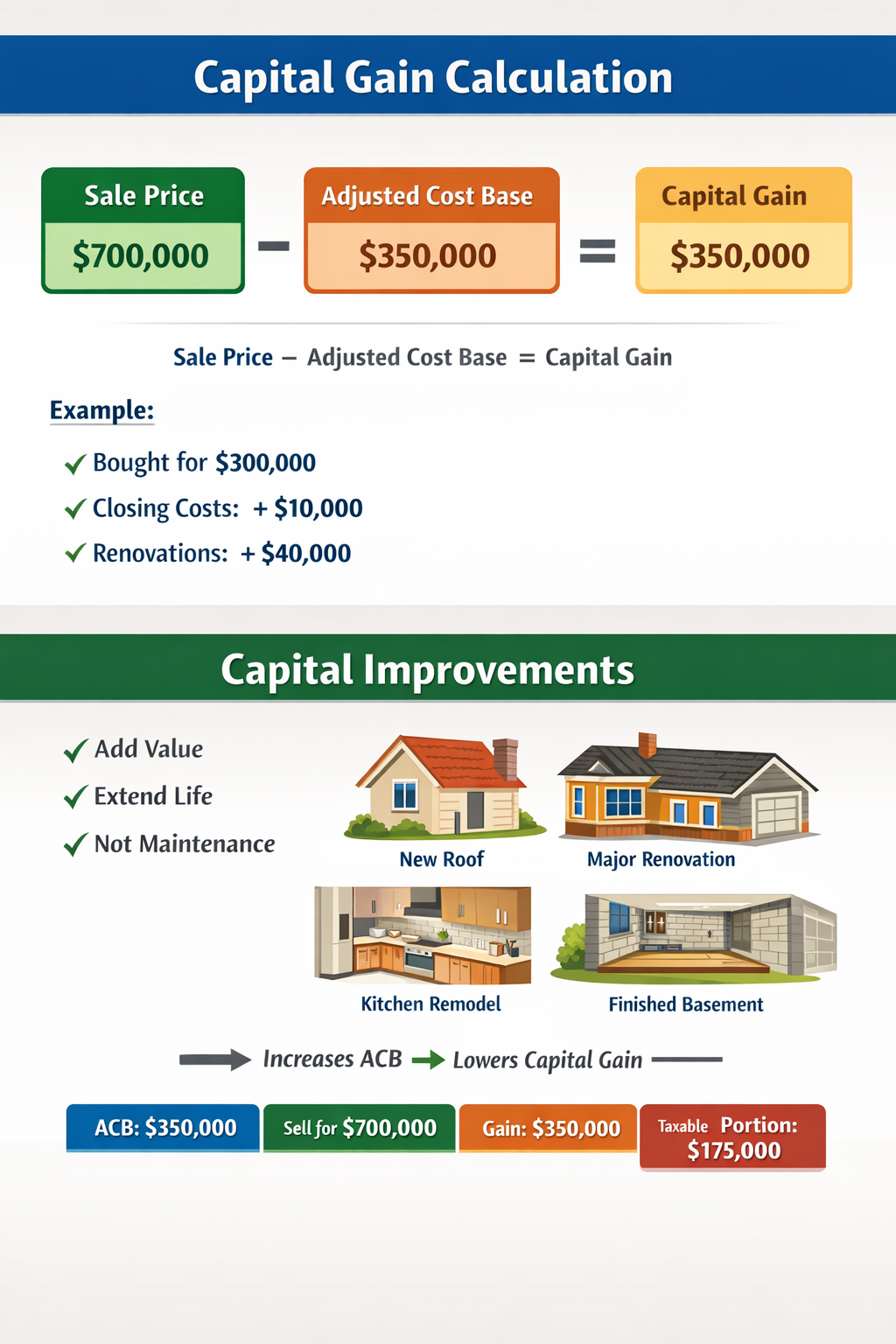
Consider a property purchased for $300,000, with $10,000 in closing costs and $40,000 in capital improvements. The adjusted cost base becomes $350,000. Selling the property for $700,000 results in a $350,000 gain, not $400,000. Half of that amount, or $175,000, becomes taxable income. Adding that income to pensions, RRSP withdrawals, or other earnings can push the owner into a higher tax bracket.
The calculation becomes clearer when broken down visually:
A common outcome is that taxpayers face greater tax liability than expected, not just because the gain itself triggers it, but also because of the timing and interaction with other income.
If you have claimed depreciation over the years, you may need to recapture some of it and pay taxes on that amount as income at the time of sale, separate from the capital gain.
Some investors choose not to maximize depreciation claims each year, recognizing that recaptured depreciation is taxed as income at the time of sale, which can increase the overall tax burden later.
The Canada Revenue Agency provides a comprehensive guide. This guide details the calculation and reporting of capital gains, with examples of common situations and their reporting needs.
Selling isn’t the sole trigger for capital gains.
A sale is only one of several events that can trigger tax.
Adding a child to the title can trigger capital gains tax because tax authorities consider the transfer a sale at fair market value. Many owners assume this is a simple gift, but the Canada Revenue Agency views it as a sale, meaning capital gains tax may apply even if no money changes hands.
These rules apply regardless of intent.
Gifting a property during your lifetime produces the same result. The Canada Revenue Agency calculates the gain based on market value, not the transfer price.
Selling below market value does not change the outcome. The property’s worth, not the price paid between family members, still determines the gain.
Selling a rental property and managing timing
Selling provides a clean exit. The process converts the property to cash, ends ongoing responsibilities, and reduces future uncertainty.
The issue is the concentration of income in a single year.
When owners receive a lump sum, they include it in their other income. That stacking effect can move an owner into a higher marginal tax bracket, increasing the overall tax rate applied to the gain.
RRSP withdrawals, pension income, or other taxable events in the same year often magnify the impact when combined.
The Canada Revenue Agency outlines how it records and includes capital gains in income, besides calculating capital gains at the time of sale and reporting them correctly on your tax return.
You use Schedule 3 of your tax return to report, recording each disposition and calculating the taxable portion before carrying it forward to line 12700.
Owners with more than one property can benefit from timing sales across different years, as the year of sale affects the total tax outcome. Even a one-year difference can significantly change the overall tax liability, especially if income levels fluctuate or other taxable events occur in the same year.
It may also be possible to structure the sale of a single property so that you receive proceeds over time rather than as a lump sum. Depending on how the agreement is arranged, this spreads the taxable portion of the gain across multiple years.
Holding the rental property until death
People often view holding a rental property for life as the simplest option. The intention is to leave the property to the children and avoid dealing with a sale.
Upon death, the estate owner disposes of the property at fair market value. The estate calculates and reports the accrued gain on its last tax return.
The estate pays the tax before distributing the remaining value.
In some situations, the estate may need to sell assets, including the property itself, to cover the tax liability.
Children receive the property or its proceeds, with the capital gains tax already accounted for.
When property changes hands during one’s lifetime, tax, probate, and ownership structure all impact the result.
👉 Link “transferred during a lifetime”
Transferring a rental property to children during your lifetime
Transferring a rental property while still living in it can help reduce future complications.
From a tax perspective, the same rules apply: the tax authorities treat the transfer as a sale at fair market value
Transferring property can trigger capital gains tax based on market value at the time of transfer.
They calculate the gain and then add the taxable portion to your income for that year.
Control over the property also changes at that point.
Once someone shares or transfers ownership, a child’s financial circumstances, including creditors or relationship breakdowns, may also expose the property.
Family dynamics, financial exposure, and long-term planning all factor into the decision.
Using a corporation for family ownership
In more complex situations, corporations are sometimes used to hold property across generations.
The transfer of individually owned property into a corporation makes up a disposition at market value. The transfer typically triggers capital gains tax.
Corporations usually tax rental income at higher passive income rates, but specific planning can prevent this. When you later withdraw funds, personal tax can also apply.
Sometimes, after a corporation pays corporate taxes on income, shareholders may incur another tax when they receive distributions.
When parents pass on the corporation to their children, the children receive ownership of the shares, not the property itself. The real estate remains within the corporation, along with any unrealized capital gain.
Decisions about ownership structure made at the time of purchase often determine the tax outcome years later when someone sells or transfers the property.
When can someone reduce or defer capital gains tax?
You often cannot avoid capital gains tax on rental property, but managing it more effectively is possible with proper planning. Professional guidance can help owners feel supported in this process.
Exemption from tax on part of the gain is possible if the owner’s principal residence was the property at any stage. The exemption can apply when the owner lived in the property before or after using it as a rental. The property’s use determines the exemption.
In certain cases, elections related to a change in use can defer the triggering of tax, allowing the timing of the gain to be managed more carefully.
You can sometimes defer capital gains tax by transferring property to your children at cost rather than market value during your lifetime. Similarly, using a corporation to hold property may allow for more flexible timing and potential deferral, but owners should understand the implications of these strategies on future tax liabilities.
Timing also plays a role. Selling during lower-income years, such as early retirement, can reduce the effective tax rate applied to the gain. Owners with more than one property may benefit from spreading sales across multiple years.
Losses, while not desirable, can offset gains in some situations and reduce overall tax exposure.
The ability to use these strategies depends on how the owners structured and used the property.
These situations are not automatic and depend on how you used and documented the rental property over time, which is why accurate records matter.
Practical approaches that reduce unnecessary tax pressure
Usually, you can’t entirely avoid capital gains tax on rental property. The focus shifts to managing timing, structure, and overall impact.

Selling during lower-income years can reduce the effective tax rate applied to the gain. Staggering the sale of multiple properties spreads income across years rather than concentrating it in a single year.
Refinancing instead of selling can provide access to equity without triggering a disposition.
Instead of selling, some owners opt to refinance as an exit strategy, particularly when they can fulfill income requirements without incurring taxes. Taxes remain an obligation.
It merely pushes the liability forward, allowing continued use of the property’s value.
Clear documentation and early planning matter. Decisions made years in advance provide more flexibility than those made under pressure.
A grounded perspective
Rental properties have served many owners well. Income, appreciation, and flexibility all contributed to that success.
The final stage requires the same level of attention.
When you understand how capital gains trigger, how different transfer methods affect treatment, and how timing influences outcomes, you can make better decisions and encounter fewer surprises.
Frequently asked questions
What’s the timeframe for paying capital gains tax on a rental property?
Capital gains tax is payable in the year the property is disposed of, whether through sale, transfer, or at death. You add the taxable portion of the gain to your income for that year.
Can you avoid capital gains tax on a rental property?
It is not possible to avoid it entirely in most situations. Certain circumstances may reduce or defer it, particularly where principal residence rules or timing strategies apply.
What happens if I add my child to the title?
When you add a child to the title, fair market value applies to the partial sale. Capital gains tax may apply immediately on the portion transferred.
Is gifting a rental property tax-free?
No, they treat the transfer as a sale at market value, and they calculate capital gains tax accordingly.
Do my children inherit my rental property tax-free?
No, you cannot transfer a rental property tax-free. Before distributing assets, the estate treats the property as if it had disposed of it at fair market value at death. Then, it calculates and pays any capital gains tax.
They have already settled the tax on the increase in the property’s value up to that point, allowing the children to receive it still. The value they receive is effectively after tax, not tax-free.
Any future growth after they inherit the property is then their responsibility. If they later sell, capital gains tax will apply based on the new value at the time they received it.
Can I move into my rental property to reduce capital gains tax?
Living in the property may allow it to qualify as a principal residence in the future, but it does not eliminate tax on the years it was a rental.
Don’t miss these guides.
Understanding how capital gains affect rental property is only part of the picture. These guides expand on ownership transfer, estate planning, and selling decisions, helping you structure your next move with greater clarity.
Multi-Generational Living in Kingston and Area
Explores how families are adapting to rising housing costs, inheritance planning, and changing household needs through shared ownership and living arrangements.
Explains pricing, timing, and preparation decisions that directly affect financial outcomes when selling a rental property.
Transferring Property to Family in Ontario: Tax, Probate, and Related Expenses
It outlines how they manage ownership transfers and where you might encounter tax, probate, and legal costs when transferring property to family.
Spousal Buyout: What Happens to the Home in Ontario?
Explains how parties value and transfer property, aiding in the understanding of how ownership shifts can lead to tax consequences.
Selling an Estate Property in Ontario
Provides guidance for executors and beneficiaries dealing with inherited real estate, probate requirements, and the practical steps involved in a sale.