


July 2026 brought some encouraging changes to the Kingston and area real estate market. Sales improved from June; fewer new listings came onto the market, and inventory edged lower. Those changes tightened market conditions, although the numbers do not suggest a sudden return to the fast-moving seller’s market seen earlier this decade.
The important story in July 2026 is that the market improved without becoming overheated. Buyers still had considerably more choice than during the pandemic years, while sellers saw somewhat better conditions than they had experienced earlier this year.
July 2026 brought a tighter Kingston market.
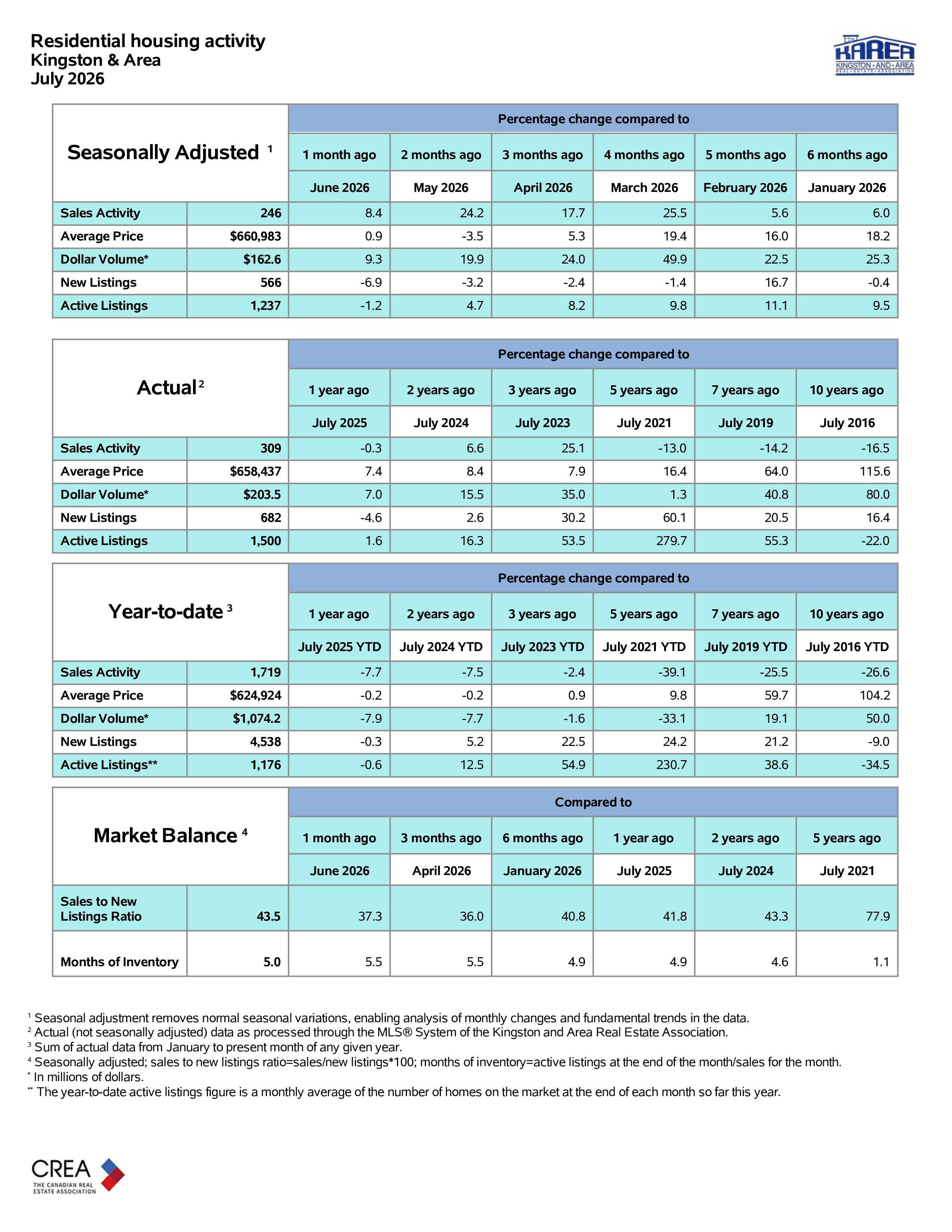
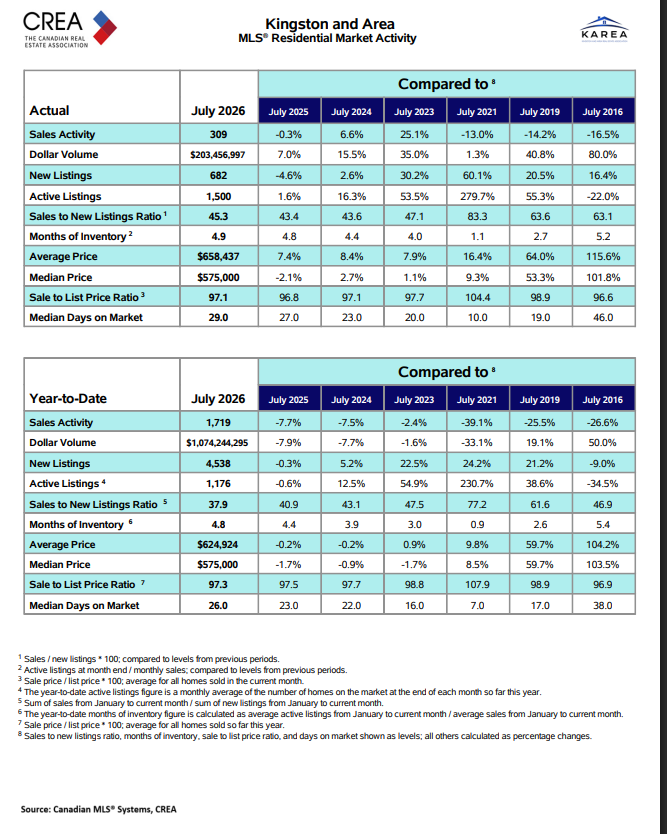
There were 309 residential sales across Kingston and area during the month, almost identical to the 310 sales recorded in July 2025. New listings declined 4.6% year over year to 682, while active listings increased slightly to 1,500. Months of inventory stood at 4.9.
The month-to-month comparison is more revealing.
On a seasonally adjusted basis, sales increased 8.4% from June, while new listings declined 6.9% and active listings slipped 1.2%.
That combination moved the seasonally adjusted sales-to-new-listings ratio from 37.3% in June to 43.5% in July 2026. Months of inventory declined from 5.5 to 5.0.
The market therefore tightened from both directions. More buyers completed purchases, while fewer new properties came onto the market.
That is a more meaningful improvement than simply seeing one monthly price figure rise.
Average, median, and benchmark prices tell different stories.
The average residential sale price reached $658,437, an increase of 7.4% from July 2025.
Taken on its own, that could make July 2026 look like a month of strong price appreciation. The other price measures tell a much more restrained story.
The median sale price was $575,000, down 2.1% from a year earlier.
The MLS® Home Price Index provides another perspective. The Kingston and area composite benchmark price was $552,500, up 0.5% from one month earlier but down 0.6% from July 2025. Down 0.9% year over year, the single-family benchmark price was $577,000. The townhouse benchmark declined 2.9%, while the apartment benchmark was down 5.3%.
That leaves us with three very different measures. The average price rose 7.4%, the median declined 2.1%, and the composite benchmark declined 0.6%.
There is no contradiction between those numbers. Average prices can vary substantially depending on the mix of properties that sell during a particular month. If higher-priced homes sell, the average can increase without the typical property gaining anywhere close to the same amount.
For buyers and sellers trying to understand current value, median prices, benchmark prices, recent comparable sales, and present competition all deserve consideration.
Single-family sales improved
Single-family homes had a stronger July 2026 than the overall residential market.
There were 257 single-family sales, up 6.2% from July 2025. New listings increased only 1.1%, while the sales-to-new-listings ratio improved to 44.6%.
The average single-family sale price rose 6.6% to $689,725. Once again, however, the median moved differently. At $590,000, it was 3.8% lower than a year earlier.
Homes also took somewhat longer to sell. Median days on market increased from 25.5 days in July 2025 to 28 days this year.
Those figures suggest buyers remain price conscious even as sales activity improves.
Townhouses and apartments are very different markets.
Townhouses remain considerably tighter than the overall Kingston and area market.
July townhouse sales declined 19.4% year over year, but new listings also fell 18.2%, and active listings declined 12.1%. The sales-to-new-listings ratio was 64.4%, with only 3.0 months of inventory.
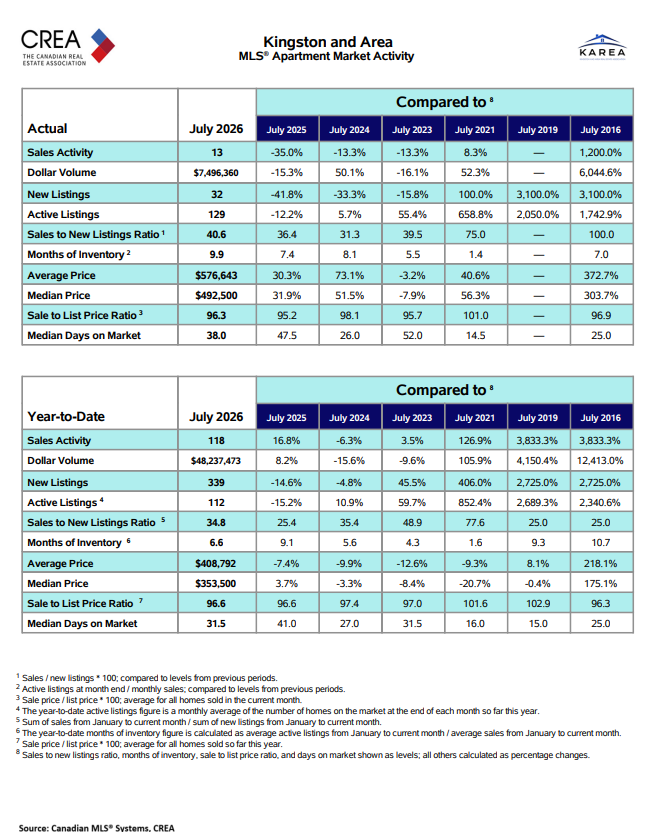
Apartment-style properties were much softer in July 2026. Only 13 sales occurred, a 35% decrease from the previous year, while inventory reached 9.9 months.
Because apartment sales volumes are relatively small, interpret large monthly movements in average or median prices with caution. A handful of high-priced or lower-priced transactions can have an outsized effect on the monthly result.
The year-to-date market remains slower than 2025
One stronger month does not erase the slower first half of the year.
Through the end of July 2026, there had been 1,719 residential sales across Kingston and area. That was 7.7% below the same period in 2025.
New listings totalled 4,538, almost unchanged from last year. The average price of $624,924 was down 0.2%, while the year-to-date median of $575,000 was down 1.7%.
Months of inventory averaged 4.8 compared with 4.4 during the same period last year.
July therefore represents improving momentum rather than a complete reversal of the market conditions experienced earlier in 2026.
Ontario’s housing recovery may finally be starting.
Kingston’s improvement fits reasonably well with the broader Ontario picture.
The Canadian Real Estate Association revised its national forecast on July 15 after a weaker-than-expected first half of 2026. CREA says a recovery in Canadian home sales appears to have begun in May, with Ontario leading the initial improvement.
CREA now forecasts 463,336 Canadian residential sales in 2026, down 1.4% from 2025. Ontario is the only province forecast to record an annual increase in sales this year. CREA expects the national average price to increase 1.1% to $686,710, while forecasts predict average prices in Ontario will decline by less than 1%.
That is important context for the Kingston results. Rather than pointing toward another housing boom, the July 2026 numbers may indicate a gradual improvement following a slow first half of the year.
Fewer listings can tighten a housing market.
Another trend is emerging elsewhere in Ontario that is worth watching locally.
In the Greater Toronto Area, July sales declined only 0.9% from a year earlier, but new listings fell 17.8% and active listings dropped 12.1%. That pushed the sales-to-new-listings ratio slightly higher and reduced months of inventory.
Housing analyst Daniel Foch argues that Toronto’s market tightened primarily because sellers reduced supply rather than because buyers suddenly returned in large numbers.
GTA market conditions do not apply locally, as Kingston differs from Toronto. However, there is an interesting similarity.
Kingston and area saw seasonally adjusted sales rise 8.4% from June, while new listings declined 6.9%. Here, the July 2026 improvement appears to reflect both stronger buyer activity and reduced fresh supply.
Whether that continues into the fall will help determine whether the market is genuinely moving toward more balanced conditions.
Has Ontario housing become more affordable?
There has also been some improvement in Ontario housing affordability since the peak of 2022.
New data from the Municipal Property Assessment Corporation shows that nearly 24% of Ontario homes are now valued below $500,000, compared with about 17% in 2022. Approximately 55% of Ontario homes are now valued below $750,000.
Condominiums account for much of that improvement. The proportion of Ontario condos valued below $500,000 increased from 24% in 2022 to 46% in 2026. Detached homes remain considerably less accessible, with only 18% valued below $500,000.
The longer-term numbers put that improvement into perspective.
In 2016, approximately 67% of homes in Ontario were valued at under $500,000. Despite the increase since 2022, fewer than one-quarter fall below that level today. MPAC also stresses that changes vary considerably between communities and property types.
Some of the extreme loss of affordability experienced during the pandemic housing boom has therefore been reversed, but affordability remains a substantial challenge.
What July means for Kingston and area buyers
Buyers continued to have a meaningful choice in July 2026. Overall inventory remained close to five months, benchmark prices were slightly below last year’s level, and homes took longer to sell than during the highly competitive markets of a few years ago.
July was noticeably tighter than June.
Buyers waiting for prices to continue falling indefinitely should recognize that stronger sales, combined with fewer new listings, can gradually reduce their negotiating leverage. That does not mean buyers need to rush. It means that attractive homes priced realistically can still generate strong interest.
Financing, property condition, future repairs, closing costs, and monthly ownership costs all remain important factors in the buying decision.
What July means for Kingston and area sellers
For sellers, July 2026 offered some encouraging signs, but realistic pricing remains essential.
The 7.4% increase in the average sale price does not mean every Kingston-area home increased in value by 7.4% over the past year. Both the median price and the MLS® HPI benchmark show a much flatter pricing environment.
Current competition matters. Sellers need to look at what has sold recently, which listings buyers have rejected, how long comparable homes are taking to sell, and what competing properties are available today.
A well-presented home in the right market position will still draw in committed buyers. An asking price based on an earlier market or an unusually high comparable sale may be much harder to justify.
July was neither a return to a seller-dominated market nor another month of broad deterioration.
It was a month when sales strengthened, fewer new listings entered the market, inventory eased, and Kingston and area moved somewhat closer to balance.
The August numbers will help us tell whether July 2026 marked the beginning of a more sustained recovery or simply a stronger month in an otherwise slower year.
If you want to see how conditions changed from the previous month, you can also read the June 2026 Kingston real estate market update
Market Pulse
July’s numbers reinforce buyers’ and sellers’ ground-level observations: the market no longer compels every buyer to decide immediately just because a home is listed. With close to five months of overall inventory, buyers have more choice, more time to compare properties, and more opportunity to negotiate than they did during the highly competitive markets of a few years ago.
That does not mean suitable homes are being ignored. Properties that are well maintained, appropriately priced, and appealing to today’s buyers can still attract strong interest. The bigger change is that buyers have become more selective, and sellers must compete more carefully for their attention.
There is also no single Kingston and area market. July’s figures show that conditions vary considerably by property type. Townhouses remained relatively tight with only 3.0 months of inventory, while apartment-style properties had 9.9 months. Location, price range, condition, and the amount of competing inventory can all make a significant difference.
For buyers, that means taking the time to evaluate value, condition, and financing rather than assuming every property requires an aggressive offer. For sellers, it means realistic pricing and strong presentation from the beginning. July 2026 demonstrated that buyers still prepare to act when the right home appears, but they increasingly refuse to overpay for the wrong one.