



What’s the difference between a home appraisal, a market report, a CMA, and assessed value?
One of the most common requests I receive from homeowners is, “Could you do an appraisal of my home?”
It’s an understandable question, but it’s essential to clarify this at the outset. As a REALTOR®, I cannot provide a formal appraisal. Regulations require licensed appraisers to complete appraisals. What I can provide is a current market report, which serves a singular purpose.
The terminology sounds similar, but the intent behind each number is different. Add in terms like CMA and assessed value, and it’s easy to see why people get confused.
Home appraisals: conservative by design
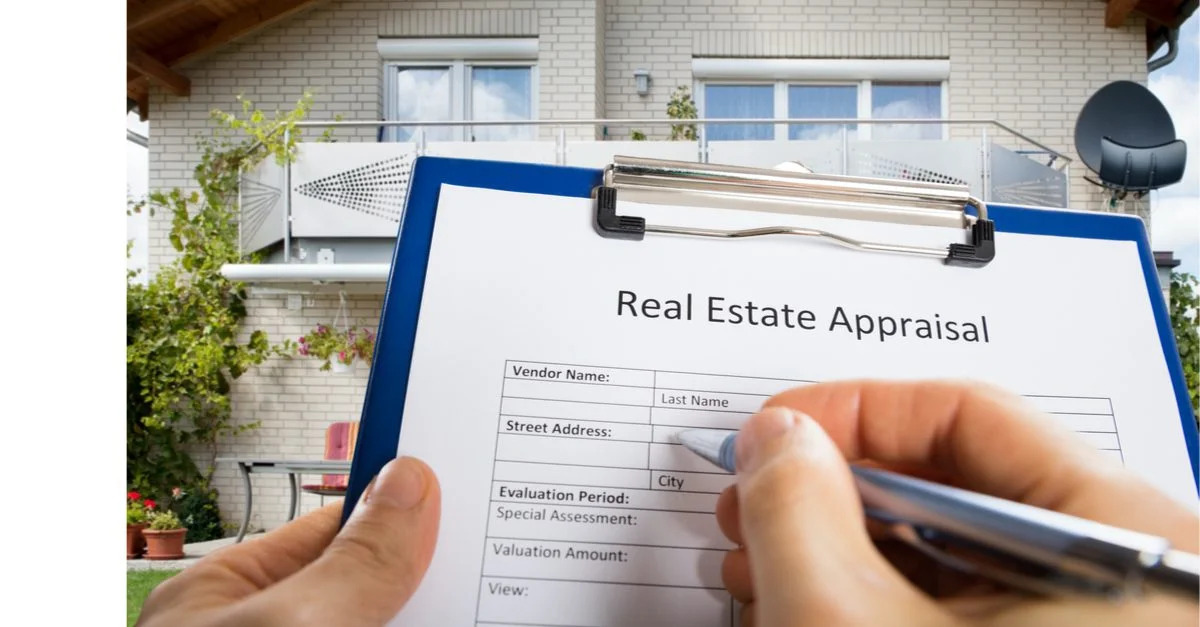
An independent, licensed appraiser completes a home appraisal. Appraisers follow strict professional standards and are legally responsible for their valuations. Their role is not to predict what a motivated buyer might pay in a competitive market. Their role is to establish a defensible value at a specific point in time using standardized methods.
In real transactions, appraisals are most often required by lenders, usually after a property has sold conditionally. The lender wants confirmation that the agreed-upon price aligns with lending risk. This differs from the role of a market report, which is used earlier in the process to guide pricing and decision-making.
For that reason, appraisals are conservative. They rely heavily on recent comparable sales and can be slower to reflect sudden market shifts, strong buyer demand, or micro-location factors that are obvious to local buyers but harder to quantify formally. That does not make them wrong. It simply means they are answering a different question than most buyers and sellers are asking.
Market reports: focused on buyer behaviour today.
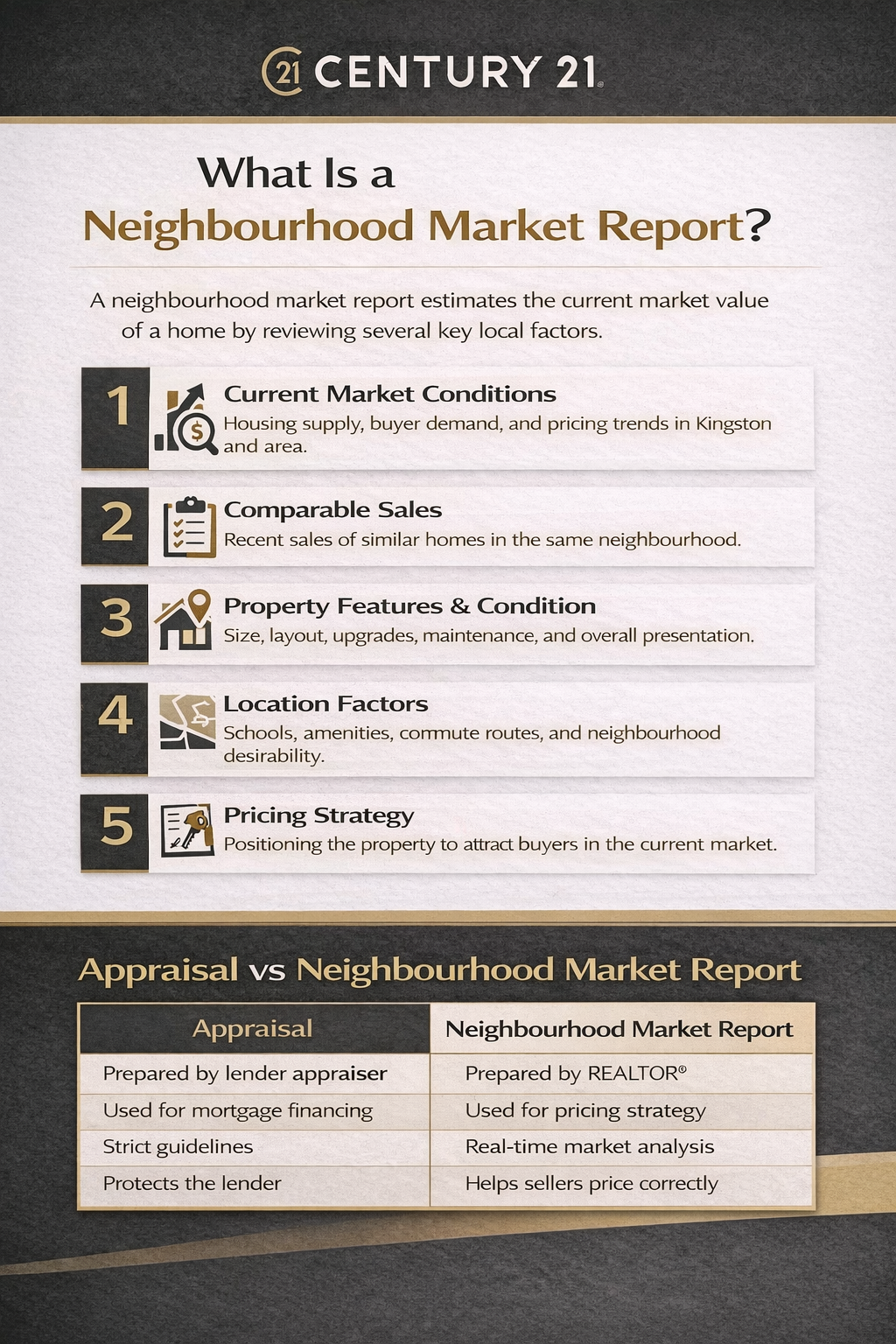
A current market report is what I prepare for clients who are buying or selling. You will sometimes hear this referred to as a Comparative Market Analysis, or CMA, but that label can be misleading because the quality and approach vary widely.
A proper market report focuses on what buyers are doing right now. It looks at recent sales, current listings, expired listings, days on market, and how properties are actually being compared in the field. You can find some information at CREA.
This is where location becomes critical, particularly in a city like Kingston. Two homes of similar size, age, and features can perform differently depending on their neighbourhood, street, proximity to schools or water, traffic patterns, or even which side of the road they are on. Buyers intuitively understand these differences, even when they are difficult to capture in a formula.
Where I part ways with many traditional CMAs is in the reliance on rigid, formula-based adjustments. You will often see reports that add or subtract fixed dollar amounts for bedrooms, bathrooms, garages, or square footage. Assigning a flat dollar value to an extra bedroom may look tidy on paper, but it often oversimplifies reality.
Buyers do not shop by spreadsheet. They respond to layout, flow, condition, light, privacy, location, and how a home feels compared to the alternatives they are seeing. An extra bedroom which compromises the main-floor layout may add little value, while a well-designed den or main-floor office may be far more appealing. Similarly, a home five minutes closer to downtown, the lake, or a preferred school catchment can matter more than an additional room.
A well-prepared market report weighs those factors in context. It asks a simple but essential question: if a buyer walked through this home and then viewed the most relevant alternatives, where would this one land?

Traditional CMAs: same name, different results
The term CMA gets used loosely in the industry, and that is part of the problem. Sometimes, a CMA is a thoughtful, manually adjusted analysis prepared by an experienced agent with strong local knowledge. In other cases, it is an automated output with preset values and minimal interpretation.
Both may carry the same label, but they are not the same tool
When CMAs lean too heavily on fixed adjustments, they can create a false sense of precision. Real estate markets are not uniform, especially in a city with a mix of historic neighbourhoods, newer subdivisions, waterfront areas, and rural pockets just minutes apart. Two houses with the same number of bedrooms can sell for very different prices depending on condition, setting, and buyer perception.
Context matters more than formulas.
Assessed value: practical for taxes, not for pricing
People often pull assessed value into pricing conversations, and they almost always misunderstand it.
In Ontario, MPAC (Municipal Property Assessment Corporation) produces assessed values for property taxation. These assessments are based on province-wide valuation dates rather than current market activity. The COVID period caused Ontario to postpone the reassessment cycle. Therefore, many properties still use values tied to January 1, 2016, for their assessments, even though the real estate market has changed significantly since then.
As a result, the assessed value is rarely a reliable indicator of what a home would sell for today. It can be higher or lower than market value, sometimes by a wide margin, and it should not be used to price a home or evaluate an offer.
In a typical sale, a current market report guides the asking price. Buyers make offers based on comparable options, location, and perceived value. Once the seller accepts an offer, the lender may confirm financing by ordering an appraisal.

Realistic pricing, aligned with current market dynamics, minimizes appraisal problems. Problems occur when pricing is based on outdated assessments, rigid formulas, or assumptions that do not reflect how buyers are actually behaving in a specific area.
The takeaway
A REALTOR® does not provide appraisals. What we provide is market insight.
A good market report is not about assigning dollar values to individual features. The focus is on understanding competition, demand, location, and buyer psychology for a specific place and time.
Instead of asking, “What’s my house worth on paper?” a better question arises when you’re thinking of selling or buying.”
The question is, how will potential buyers evaluate this property compared to other homes on the market?
A well-prepared market report should address that very question.
Frequently asked questions
Can I use a market report instead of an appraisal?
A market report is used to guide pricing and decisions. An appraisal is usually required by a lender for financing and serves a different purpose.
Why does my neighbour’s house seem to be worth more than mine?
Slight differences in location, lot characteristics, updates, and buyer perception can have a significant impact on value, even between nearby properties.
Does an extra bedroom always increase value?
Not necessarily. Layout, flow, and overall usability often matter more than the number of rooms alone.
Why doesn’t the assessed value match the market value?
These assessed values, tied to earlier valuation dates, serve tax functions rather than reflecting current market prices.
At what point is an appraisal usually conducted?
Once there is an accepted offer, the lender starts the financing procedures.
📚 Don’t Miss These Guides
Understanding the difference between an appraisal and a market evaluation is only one part of how property value is determined. Factors like financing, property condition, location, and market timing play a role in determining home prices and sales within Kingston and the adjacent Frontenac, Lennox, and Leeds communities. These related guides explore other factors that affect value and pricing decisions.
Relocating to Kingston and Area 2026
Moving into a new market requires understanding local pricing trends, neighbourhood differences, and buyer demand. This guide helps newcomers interpret property values and market conditions in Kingston and the surrounding Frontenac, Lennox, and Leeds communities.
First Home Purchase: Kingston Area
First-time buyers consider understanding home valuation to be especially important. Learn how mortgage financing, lender appraisals, market evaluations, and negotiation strategies intersect when purchasing property in Kingston and the surrounding Frontenac, Lennox, and Leeds communities.
Selling the Family Home
When preparing to sell, pricing becomes one of the most important decisions a homeowner will make. This guide explains how condition, timing, and presentation influence market value and buyer interest in Kingston and the surrounding Frontenac, Lennox, and Leeds communities.
Purchasing a Fixer-Upper in Kingston and the Area
Renovation potential can complicate valuation. This guide explains how repair estimates, condition issues, and comparable sales factor into pricing decisions when buyers consider fixer-upper properties in Kingston and surrounding Frontenac, Lennox, and Leeds communities.