
What Kingston area homeowners need to know
Reverse mortgages are becoming more visible throughout Kingston and the surrounding communities. Increasing home values have significantly boosted seniors’ equity, but they are facing financial pressure from the rising cost of living. While a reverse mortgage seems simple for a senior, it can trap them if they don’t grasp all the ongoing costs.
Many homeowners do not realize how quickly interest compounds, causing the debt to grow faster than expected and significantly draining their home equity. Understanding this helps you see the actual long-term costs and avoid surprises.

What a reverse mortgage is
A reverse mortgage is a loan secured against your home and available to Canadians aged 55 or older. You continue to own the home and live in it, but you do not make monthly payments. The balance increases with added interest each month. Repayment of the loan is required when you sell the home, move permanently, or pass away.
Most lenders allow access to a portion of your equity, often up to about 55 percent of the home’s value.
How it works
Approval is based on your age, the market value of your property, where the home is located, and the current interest rate environment. Older borrowers qualify for higher amounts because lenders expect shorter borrowing periods.
You have the option to take the funds all at once or to draw them as a monthly income. Since there are no required payments, the interest compounds, which means the balance grows a little faster every month. The home’s current market value, rather than its value on the day you signed, will dictate the repayment amount when it’s finally triggered.
One protection is the no-negative-equity guarantee. If the home’s value drops and the loan exceeds the sale price, the lender absorbs the difference. Your family is not responsible for the shortfall.
Couples also need to understand the structure of the reverse mortgage. Usually, if both partners or spouses are borrowers, the surviving one can keep living in the home according to the current agreement. However, the lender could call in the loan when the individual listed on the reverse mortgage passes away or moves out permanently. Request the lender to explain exactly how they will handle your case before you sign.
The good parts
The primary draw for many older adults is the option to stay in their residences and secure non-taxable funds. This money won’t change your OAS or GIS benefits and can cover medical needs, mobility improvements, heating system upgrades, or debt.
Reverse mortgages do not require income or credit approval, which helps seniors who no longer qualify for traditional products. They do not require monthly payments either, which can make day-to-day living easier for homeowners on a fixed income.
When a Reverse Mortgage Can Become a Trap
The problem is that most borrowers underestimate how quickly interest grows when no payments are being made. After several years, the loan can take a larger share of the home’s equity than expected. Lenders also impose steep penalties for early repayment, and registering a reverse mortgage on title restricts other financing options.
The situation becomes even riskier when property taxes, home insurance, or maintenance fall behind. Failure to uphold any of these duties could cause the reverse mortgage lender to demand full repayment.
Independent legal advice can help you understand the long-term costs, your obligations, and whether a reverse mortgage is truly the best option for your circumstances.
Lenders design reverse mortgages as long-term financial tools. If you are planning to downsize, relocate closer to family, or move into a retirement community within the next few years, the costs of setting up the loan and any early repayment penalties may outweigh the benefits. While some reverse mortgages may allow a homeowner to transfer them to another property, the lender’s requirements and the new home’s value cause an individual assessment.
A reverse mortgage may also not be the best choice if your need for cash is only temporary. Whether you are helping a family member, bridging a short-term financial gap, or planning renovations before selling your home, there may be lower-cost alternatives. A Home Equity Line of Credit (HELOC), conventional refinance, or other financing solution could prove more economical if you qualify.
Finally, reverse mortgages can affect family expectations. Adult children sometimes assume they will inherit the family home with little or no debt attached. Having an open discussion before signing helps everyone understand the decision and can prevent misunderstandings later.
The costly side
Reverse mortgages carry higher interest rates than mortgages, refinances, or HELOCs. In Canada, the rates typically range from 7 to 10 percent. Appraisal, administrative, and legal fees also apply, and penalties exist if you pay off the loan early.
The balance grows every month because interest compounds. The longer the loan remains active, the faster the balance increases, which can significantly reduce the inheritance left to your children or your estate.
Interest rates compared with HELOCs
The closest comparison for most homeowners is a HELOC (Home Equity Line of Credit). Most banks that you already work with will typically offer HELOCs. They require income and credit qualification, but the rates are typically far lower, often at prime plus a small percentage. In late 2025, that usually means between 6 and 8 percent.
The cost difference over several years can be substantial. HELOCs require monthly interest payments, whereas reverse mortgages do not, which is why their rates and fees are higher.
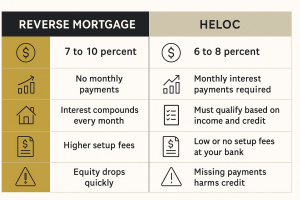
People often compare reverse mortgages with a HELOC since both let homeowners borrow against their home’s equity. The important difference is that people who have sufficient income to make monthly payments usually intend to use a HELOC. If you qualify, it will almost always be the lower-cost solution. A reverse mortgage helps homeowners access their equity without taking on another monthly financial obligation.
One of the biggest misconceptions is that the amount borrowed remains relatively stable. It does not. Since the borrower does not need to make monthly payments, interest continually adds to the balance, and the lender then calculates future interest on that higher amount. Borrowing $200,000 today does not mean you will owe only $200,000 years from now.
Depending on interest rates and how long the reverse mortgage remains in place, the balance can grow substantially. Making occasional voluntary payments, when possible, can help slow that growth and preserve more of your home’s equity.
Scams and risks in Kingston and surrounding communities
The rise in reverse mortgages has led to an increase in scams. Some scams involve fake lender letters or fraudulent refinancing documents. Others hide behind online calculators designed to gather personal information. Be wary of contractors who push seniors toward reverse mortgages for renovations; it’s a major red flag.
Pressure from acquaintances, caregivers, or distant relatives is another concern. Independent legal advice is essential, and so is taking time to understand every term.
Misleading sales calls also occur. Some representatives gloss over penalties or long-term costs and focus only on the immediate cash. Always ask for written details and bring a trusted family member to meetings.
When a reverse mortgage may help
A reverse mortgage can make sense when a homeowner wants to remain in their home long term, does not qualify for a HELOC, and needs reliable access to funds for health care, accessibility, or significant repairs. It can also help homeowners who have no heirs or whose heirs support their decision to use some of the home’s equity now.
When a reverse mortgage can cause problems
It is rarely a good idea for anyone planning to move, downsize, or sell within a few years, or for anyone whose home needs significant repairs. If you’re concerned about keeping up with taxes or insurance, or want to leave an inheritance, a reverse mortgage may not be the best choice. Recognizing these signs helps you make safer decisions.
How to protect yourself or your parents
Entering a reverse mortgage should always involve a review with an independent lawyer and a comparison of all options, including HELOCs, refinancing, downsizing, or provincial support programs. By reviewing the options, you can choose the most suitable and cost-effective solution for your situation.

Even making occasional voluntary payments can slow the long-term interest growth and preserve more equity.
Never feel pressured to sign during your first meeting with a lender. Take the documents home, review them carefully, discuss the decision with family members if appropriate, and ask your lawyer to explain anything that is unclear. You should never rush a reverse mortgage because it is a major financial commitment.
Before you sign, ensure you understand how the interest is calculated, whether the rate is a fixed rate or variable, and what could happen if you later move into long-term care or decide to sell your home. Compare the reverse mortgage with alternatives such as a HELOC, refinancing, downsizing, or selling and purchasing a less expensive property. The best financial decision is rarely the quickest one.
Frequently asked questions
Is a reverse mortgage a good idea?
It depends on income, long-term plans, and the ability to maintain the home. It can help with cash flow, but the long-term cost is high.
What happens if I fall behind on property taxes or insurance?
The lender may demand full repayment, and this poses one of the most serious risks that requires consideration before signing.
Which value do they use when the loan ends?
At repayment or sale, the current market value applies, not the value from the day of original paperwork completion.
How much can I borrow?
Often up to about 55 percent of the home’s value.
What does HELOC mean?
HELOC stands for Home Equity Line of Credit. It is a revolving line of credit secured by your home.
Is a HELOC usually through the banks?
Yes. Your personal bank or credit union is most often the one that issues HELOCs.
Why choose a HELOC instead?
Lower interest rates, lower fees, and more flexibility. They are the better choice when income and credit allow.
Can I make payments on a reverse mortgage?
Yes, they permit voluntary payments, and these payments slow the growth rate of the balance.
What happens when I pass away?
Your estate must repay the balance, usually by selling the home.
📚 Don’t Miss These Guides
A reverse mortgage is only one way to access the equity in your home. These related guides explore selling, transferring property to family, maintaining your home’s value, and other important decisions that may help you compare your options before choosing the path that’s right for you.
Selling the Family Home
Selling a long-held family property often involves financial planning and emotional decisions. This guide explains how to prepare for the sale, avoid common pitfalls, and make informed decisions throughout the process.
Transfer Property to Family in Ontario, 2026
Many homeowners hope to leave their property to children or other family members. This guide explains ownership transfers, tax considerations, joint ownership, and common mistakes that can affect your estate plan.
Working With a Kingston REALTOR®
Major financial decisions often involve more than simply obtaining financing. Whether you’re considering a reverse mortgage, downsizing, transferring property to family, or selling your home, working with an experienced Kingston REALTOR® can help you understand your options, evaluate current market conditions, and make informed decisions that support your long-term goals. This guide explains how professional advice can help you avoid costly mistakes and confidently navigate every stage of the process.
Preparing Your Home for Sale: Presentation, Privacy, and Security
Whether you’re planning to sell now or in the future, preparing your home properly can make a significant difference. Learn practical steps to improve presentation, protect your privacy, and reduce unnecessary stress during the selling process.
Top 10 Kingston Home-Selling Tips for 2026
If selling becomes a better option than a reverse mortgage, this guide outlines practical strategies that help homeowners prepare their property, attract qualified buyers, and maximize its market appeal.